 |
Motore di ricerca datesheet componenti elettronici |
|
|
Motore di ricerca datesheet componenti elettronici |
|
The question interval is too short.
Please try again in a few seconds.

Hello, Please ask a question about M74HC123M1R Datasheet
# Example questions:
➢ If cx = 100pf and rx = 10kω, what is the minimum retrigger time (trr) at 0v?
➢ What is the maximum propagation delay (tplh) for the a and b inputs to the q output when the supply voltage is 4.5v?
➢ What is the minimum pulse width (tw(h) or tw(l)) required for the clr input at a supply voltage of 6.0v?
| Part No. | M74HC123M1R |
| Manufacturer | STMICROELECTRONICS |
| Size | 503 Kbytes |
| Pages | 12 pages |
| Description | DUAL RETRIGGERABLE MONOSTABLE MULTIVIBRATOR |


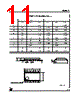


Okay, here's a breakdown of the provided data, summarizing the key information from the two tables. I'll categorize it for clarity. This is a *lot* of data, so I'll try to be concise while covering the important aspects.
Table 1: DC Characteristics (Static Values)
This table lists the electrical characteristics of the chip under static (non-changing) conditions. It details voltage levels, current consumption, and input/output parameters. Here's a summary:
️· Supply Voltage (VCC): Ranges typically between 2.0V and 6.0V.
️· Input High Voltage (VIH): The minimum voltage considered a 'high' input signal varies from around 2.0V to 3.0V depending on the VCC.
️· Input Low Voltage (VIL): The maximum voltage considered a 'low' input signal varies, generally around 0.8V to 1.0V.
️· Output High Voltage (VOH): The minimum output voltage when the output is 'high' varies depending on the load and VCC, but is typically around 2.4V to 3.0V.
️· Output Low Voltage (VOL): The maximum output voltage when the output is 'low' varies, but is usually around 0.4V to 0.8V.
️· Quiescent Current: Describes the current drawn by the chip when it's not actively switching. Values vary depending on supply voltage.
Table 2: AC Characteristics (Timing Parameters)
This table defines how quickly the chip can switch between states and process signals. These values are critical for determining the maximum operating frequency and overall performance. Key points:
️· Propagation Delay (tPLH, tPHL): The time it takes for a signal to propagate through the chip (e.g., from input A to output Q). This varies significantly with supply voltage. Ranges from around 22ns to 315ns depending on VCC.
️· Output Pulse Width (tWOUT): The minimum duration of an output pulse. This is important for generating specific timing signals. Values range from 1.1µs to 4.6µs depending on the external components and VCC.
️· Minimum Pulse Width (tW(H), tW(L)): The minimum duration a signal needs to be high or low for the chip to recognize it. These vary depending on the VCC.
️· Minimum Retrigger Time (tRR): The minimum time that must elapse between triggering events for the chip to respond correctly. Ranges from 78ns to 5µs depending on the external components and VCC.
Key Trends & Observations:
️· Voltage Dependency: Almost all the parameters in both tables are heavily dependent on the supply voltage (VCC). Higher VCC generally leads to faster switching speeds and better performance.
️· Load Dependency: AC characteristics are also influenced by external load.
️· Temperature Dependency: While not explicitly stated, AC and DC characteristics can also drift with temperature.
Let me know if you'd like me to:
️· Focus on specific parameters in more detail.
️· Compare values for different supply voltages.
️· Help you interpret these values for a particular application.
️· Extract specific numbers from the tables for your use.
Table 1: DC Characteristics (Static Values)
This table lists the electrical characteristics of the chip under static (non-changing) conditions. It details voltage levels, current consumption, and input/output parameters. Here's a summary:
️· Supply Voltage (VCC): Ranges typically between 2.0V and 6.0V.
️· Input High Voltage (VIH): The minimum voltage considered a 'high' input signal varies from around 2.0V to 3.0V depending on the VCC.
️· Input Low Voltage (VIL): The maximum voltage considered a 'low' input signal varies, generally around 0.8V to 1.0V.
️· Output High Voltage (VOH): The minimum output voltage when the output is 'high' varies depending on the load and VCC, but is typically around 2.4V to 3.0V.
️· Output Low Voltage (VOL): The maximum output voltage when the output is 'low' varies, but is usually around 0.4V to 0.8V.
️· Quiescent Current: Describes the current drawn by the chip when it's not actively switching. Values vary depending on supply voltage.
Table 2: AC Characteristics (Timing Parameters)
This table defines how quickly the chip can switch between states and process signals. These values are critical for determining the maximum operating frequency and overall performance. Key points:
️· Propagation Delay (tPLH, tPHL): The time it takes for a signal to propagate through the chip (e.g., from input A to output Q). This varies significantly with supply voltage. Ranges from around 22ns to 315ns depending on VCC.
️· Output Pulse Width (tWOUT): The minimum duration of an output pulse. This is important for generating specific timing signals. Values range from 1.1µs to 4.6µs depending on the external components and VCC.
️· Minimum Pulse Width (tW(H), tW(L)): The minimum duration a signal needs to be high or low for the chip to recognize it. These vary depending on the VCC.
️· Minimum Retrigger Time (tRR): The minimum time that must elapse between triggering events for the chip to respond correctly. Ranges from 78ns to 5µs depending on the external components and VCC.
Key Trends & Observations:
️· Voltage Dependency: Almost all the parameters in both tables are heavily dependent on the supply voltage (VCC). Higher VCC generally leads to faster switching speeds and better performance.
️· Load Dependency: AC characteristics are also influenced by external load.
️· Temperature Dependency: While not explicitly stated, AC and DC characteristics can also drift with temperature.
️· Focus on specific parameters in more detail.
️· Compare values for different supply voltages.
️· Help you interpret these values for a particular application.
️· Extract specific numbers from the tables for your use.
| Part No. | M74HC123M1R |
| Manufacturer | STMICROELECTRONICS |
| Size | 503 Kbytes |
| Pages | 12 pages |
| Description | DUAL RETRIGGERABLE MONOSTABLE MULTIVIBRATOR |
| Lei ha avuto il aiuto da alldatasheet? [ DONATE ] |
Di alldatasheet | Richest di pubblicita | contatti | Privacy Policy | Collegamento alla scheda tecnica | scambio Link | Ricerca produttore All Rights Reserved©Alldatasheet.com |
| Russian : Alldatasheetru.com | Korean : Alldatasheet.co.kr | Spanish : Alldatasheet.es | French : Alldatasheet.fr | Italian : Alldatasheetit.com Portuguese : Alldatasheetpt.com | Polish : Alldatasheet.pl | Vietnamese : Alldatasheet.vn Indian : Alldatasheet.in | Mexican : Alldatasheet.com.mx | British : Alldatasheet.co.uk | New Zealand : Alldatasheet.co.nz |
|
Family Site : ic2ic.com |
icmetro.com |
 Italian ▼
  English
 Chinese
 German
 Japanese
 Russian
 Korean
 Spanish
 French
 Portuguese
 Polish
 Vietnamese
 Indian
 Mexican
 British
 New Zealand