 |
Motore di ricerca datesheet componenti elettronici |
|
|
Motore di ricerca datesheet componenti elettronici |
|
The question interval is too short.
Please try again in a few seconds.

Hello, Please ask a question about XC228X Datasheet
# Example questions:
➢ What are the primary functions of the usic1 and usic0 modules?
➢ Several pins are described as having 'ocds' functionality. what is the likely purpose of ocds in relation to the microcontroller's operation?
➢ What can you infer about the function of these 'ccu' modules based on the pin descriptions?
| Part No. | XC228X |
| Manufacturer | INFINEON |
| Size | 2Mb |
| Pages | 110 pages |
| Description | 16/32-Bit Single-Chip Microcontroller with 32-Bit Performance |


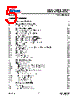


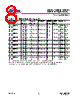


1. General Overview & Purpose
️· This is a datasheet excerpt: It's a technical document describing a microcontroller (likely part of the XC228x family).
️· Focus: It details pin configurations and functionalities. Each pin has multiple potential roles, selectable through software configuration.
️· Pin Types: Pins are categorized by their primary function and selectable configurations (e.g., General Purpose I/O, Timer Outputs, Communication Ports, Analog Multiplexer Controls).
2. Pin Configuration & Functionality (High-Level)
️· Pin Naming: Pins are identified by a port designation (P6, P7, P8) and a bit number (e.g., P7.0, P8.4).
️· 'Ctrl' Column: This column specifies the type of connection, (A or B) which likely refers to different power or signal domains.
️· 'Type' Column: Indicates the nature of the pin connection:
- St/A (Standard/Analog): Standard power and signal connections.
- St/B (Standard/Digital): Digital-focused power and signal connections.
- OH (Open Drain): Indicates an open-drain output.
- In/B: Input with a B type connection
️· Multiple Functions: Most pins are multifunctional. They can be configured to serve various purposes (e.g., a pin can be a general-purpose I/O, a timer output, or part of a communication interface). The specific function is determined by software configuration.
️· Communication Interfaces:
- USIC (Universal Serial Interface Controller): A flexible serial communication interface. Channels 0 and 1 are available, each with multiple pins (shift data output, shift data input, shift clock output, etc.).
- CAN (Controller Area Network): Pins for CAN communication (transmit data output, receive data input).
- ADC (Analog-to-Digital Converter): Pins associated with ADC conversion, including request signals.
️· Timers: Pins for timer functions (e.g., GPT1 timer T3 toggle latch output, GPT2 timer T6 toggle latch output).
️· Analog Multiplexer (EMUX): Pins used to control external analog multiplexers.
️· Debug Interface: Pins supporting an on-chip debug system (OCDS – On-Chip Debug System, TRST, TCK, TMS, BRKIN, BRKOUT).
3. Specific Pin Examples and Breakdown (Illustrative)
Let's consider a few examples to show the complexity:
️· P7.0: Can be a general-purpose I/O, a timer output (T3OUT), and part of a USIC interface. The specific role is determined by software configuration.
️· P6.3: Can be a general-purpose I/O, timer output (T3OUT), and part of a USIC interface.
️· P8.4: General purpose I/O or CCU60_COUT61.
️· ADCx_REQGTyC & ADCx_REQTRyC/D: Signals used to trigger or request actions from the ADC.
4. Key Takeaways and Implications
️· Flexibility: The microcontroller offers great flexibility due to the multi-functionality of its pins.
️· Software Configuration: The functionality of any given pin is determined by software configuration.
️· Complexity: The pin configuration is complex and requires careful consideration during hardware and software design.
️· Target Audience: This document is intended for engineers and developers designing hardware and software systems based on the XC228x microcontroller.
1. General Overview & Purpose
️· This is a datasheet excerpt: It's a technical document describing a microcontroller (likely part of the XC228x family).
️· Focus: It details pin configurations and functionalities. Each pin has multiple potential roles, selectable through software configuration.
️· Pin Types: Pins are categorized by their primary function and selectable configurations (e.g., General Purpose I/O, Timer Outputs, Communication Ports, Analog Multiplexer Controls).
2. Pin Configuration & Functionality (High-Level)
️· Pin Naming: Pins are identified by a port designation (P6, P7, P8) and a bit number (e.g., P7.0, P8.4).
️· 'Ctrl' Column: This column specifies the type of connection, (A or B) which likely refers to different power or signal domains.
️· 'Type' Column: Indicates the nature of the pin connection:
- St/A (Standard/Analog): Standard power and signal connections.
- St/B (Standard/Digital): Digital-focused power and signal connections.
- OH (Open Drain): Indicates an open-drain output.
- In/B: Input with a B type connection
️· Multiple Functions: Most pins are multifunctional. They can be configured to serve various purposes (e.g., a pin can be a general-purpose I/O, a timer output, or part of a communication interface). The specific function is determined by software configuration.
️· Communication Interfaces:
- USIC (Universal Serial Interface Controller): A flexible serial communication interface. Channels 0 and 1 are available, each with multiple pins (shift data output, shift data input, shift clock output, etc.).
- CAN (Controller Area Network): Pins for CAN communication (transmit data output, receive data input).
- ADC (Analog-to-Digital Converter): Pins associated with ADC conversion, including request signals.
️· Timers: Pins for timer functions (e.g., GPT1 timer T3 toggle latch output, GPT2 timer T6 toggle latch output).
️· Analog Multiplexer (EMUX): Pins used to control external analog multiplexers.
️· Debug Interface: Pins supporting an on-chip debug system (OCDS – On-Chip Debug System, TRST, TCK, TMS, BRKIN, BRKOUT).
3. Specific Pin Examples and Breakdown (Illustrative)
Let's consider a few examples to show the complexity:
️· P7.0: Can be a general-purpose I/O, a timer output (T3OUT), and part of a USIC interface. The specific role is determined by software configuration.
️· P6.3: Can be a general-purpose I/O, timer output (T3OUT), and part of a USIC interface.
️· P8.4: General purpose I/O or CCU60_COUT61.
️· ADCx_REQGTyC & ADCx_REQTRyC/D: Signals used to trigger or request actions from the ADC.
4. Key Takeaways and Implications
️· Flexibility: The microcontroller offers great flexibility due to the multi-functionality of its pins.
️· Software Configuration: The functionality of any given pin is determined by software configuration.
️· Complexity: The pin configuration is complex and requires careful consideration during hardware and software design.
️· Target Audience: This document is intended for engineers and developers designing hardware and software systems based on the XC228x microcontroller.
| Part No. | XC228X |
| Manufacturer | INFINEON |
| Size | 2Mb |
| Pages | 110 pages |
| Description | 16/32-Bit Single-Chip Microcontroller with 32-Bit Performance |
| Lei ha avuto il aiuto da alldatasheet? [ DONATE ] |
Di alldatasheet | Richest di pubblicita | contatti | Privacy Policy | Collegamento alla scheda tecnica | scambio Link | Ricerca produttore All Rights Reserved©Alldatasheet.com |
| Russian : Alldatasheetru.com | Korean : Alldatasheet.co.kr | Spanish : Alldatasheet.es | French : Alldatasheet.fr | Italian : Alldatasheetit.com Portuguese : Alldatasheetpt.com | Polish : Alldatasheet.pl | Vietnamese : Alldatasheet.vn Indian : Alldatasheet.in | Mexican : Alldatasheet.com.mx | British : Alldatasheet.co.uk | New Zealand : Alldatasheet.co.nz |
|
Family Site : ic2ic.com |
icmetro.com |
 Italian ▼
  English
 Chinese
 German
 Japanese
 Russian
 Korean
 Spanish
 French
 Portuguese
 Polish
 Vietnamese
 Indian
 Mexican
 British
 New Zealand