 |
Motore di ricerca datesheet componenti elettronici |
|
|
Motore di ricerca datesheet componenti elettronici |
|
The question interval is too short.
Please try again in a few seconds.

Hello, Please ask a question about ATS640B Datasheet
# Example questions:
➢ How many different crystals have a load capacitance of 20pf?
➢ List all the crystal part numbers with a frequency of 6.000000 mhz.
➢ What is the load capacitance for the ats100sm-1 crystal?
| Part No. | ATS640B |
| Manufacturer | CTS |
| Size | 181 Kbytes |
| Pages | 6 pages |
| Description | Standard HC-49/US thru-hole and HC-49/US-SM surface mount Packages |


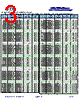


Okay, I've analyzed the provided text. Here's a breakdown of what I'm seeing and can do with it.
Content:
This text appears to be a partial catalog or datasheet excerpt for quartz crystal oscillators. It lists many different frequency options (e.g., 4.000000 MHz, 8.000000 MHz, etc.). For each frequency, it provides:
️· Reference Designator/Part Number: Something like "ATS040SM-1". The 'ATS' probably indicates a product family, and the numbers represent the frequency. The final part (SM, BS, CS) seems to denote different load capacitance or circuit variations.
️· Standard Part Number: A full part number, which is then related to the reference designator.
️· Frequency (MHz): The nominal frequency of the crystal oscillator.
️· Load Capacitance: Indicated by the ending 'SM', 'BS', or 'CS'
️· Indication of Availability: Bolded entries ("ATS...") likely denote readily available parts.
Key Observations & Patterns:
️· ATS Product Family: All listed parts seem to be within the "ATS" product family.
️· Frequency Progression: The frequencies are listed in ascending order.
️· Load Capacitance Codes: 'SM,' 'BS,' and 'CS' are important differentiating codes. There is also a "Standard Part Number" which relates to these.
What I can do with this data (and potential limitations):
1. Create a structured table: I can easily take this data and create a proper table format (e.g., CSV, Markdown, HTML table) with columns like "Frequency (MHz)", "Reference Designator/Part Number", "Standard Part Number", "Load Capacitance Code", and "Availability."
2. Search and Filter: If you give me a frequency or a "Reference Designator/Part Number," I can quickly find the corresponding entry.
3. Identify Trends: If given a larger dataset, I could potentially analyze the availability of different frequencies or load capacitances.
4. Limitations:
- This is *partial* data. It is not the entire catalog.
- I don't have context about the meaning of the product codes ('SM,' 'BS,' 'CS', etc.) beyond that they likely relate to load capacitance.
- I need more data for deeper analysis (like availability trends).
To help me further, please tell me:
* What specific information are you looking for from this data?
* Do you have a full dataset, or is this a partial excerpt?
* Are you trying to accomplish something specific with this data (e.g., build a product comparison chart)?
Content:
This text appears to be a partial catalog or datasheet excerpt for quartz crystal oscillators. It lists many different frequency options (e.g., 4.000000 MHz, 8.000000 MHz, etc.). For each frequency, it provides:
️· Reference Designator/Part Number: Something like "ATS040SM-1". The 'ATS' probably indicates a product family, and the numbers represent the frequency. The final part (SM, BS, CS) seems to denote different load capacitance or circuit variations.
️· Standard Part Number: A full part number, which is then related to the reference designator.
️· Frequency (MHz): The nominal frequency of the crystal oscillator.
️· Load Capacitance: Indicated by the ending 'SM', 'BS', or 'CS'
️· Indication of Availability: Bolded entries ("ATS...") likely denote readily available parts.
Key Observations & Patterns:
️· ATS Product Family: All listed parts seem to be within the "ATS" product family.
️· Frequency Progression: The frequencies are listed in ascending order.
️· Load Capacitance Codes: 'SM,' 'BS,' and 'CS' are important differentiating codes. There is also a "Standard Part Number" which relates to these.
What I can do with this data (and potential limitations):
1. Create a structured table: I can easily take this data and create a proper table format (e.g., CSV, Markdown, HTML table) with columns like "Frequency (MHz)", "Reference Designator/Part Number", "Standard Part Number", "Load Capacitance Code", and "Availability."
2. Search and Filter: If you give me a frequency or a "Reference Designator/Part Number," I can quickly find the corresponding entry.
3. Identify Trends: If given a larger dataset, I could potentially analyze the availability of different frequencies or load capacitances.
4. Limitations:
- This is *partial* data. It is not the entire catalog.
- I don't have context about the meaning of the product codes ('SM,' 'BS,' 'CS', etc.) beyond that they likely relate to load capacitance.
- I need more data for deeper analysis (like availability trends).
| Part No. | ATS640B |
| Manufacturer | CTS |
| Size | 181 Kbytes |
| Pages | 6 pages |
| Description | Standard HC-49/US thru-hole and HC-49/US-SM surface mount Packages |
| Lei ha avuto il aiuto da alldatasheet? [ DONATE ] |
Di alldatasheet | Richest di pubblicita | contatti | Privacy Policy | Collegamento alla scheda tecnica | scambio Link | Ricerca produttore All Rights Reserved©Alldatasheet.com |
| Russian : Alldatasheetru.com | Korean : Alldatasheet.co.kr | Spanish : Alldatasheet.es | French : Alldatasheet.fr | Italian : Alldatasheetit.com Portuguese : Alldatasheetpt.com | Polish : Alldatasheet.pl | Vietnamese : Alldatasheet.vn Indian : Alldatasheet.in | Mexican : Alldatasheet.com.mx | British : Alldatasheet.co.uk | New Zealand : Alldatasheet.co.nz |
|
Family Site : ic2ic.com |
icmetro.com |
 Italian ▼
  English
 Chinese
 German
 Japanese
 Russian
 Korean
 Spanish
 French
 Portuguese
 Polish
 Vietnamese
 Indian
 Mexican
 British
 New Zealand