 |
Motore di ricerca datesheet componenti elettronici |
|
|
Motore di ricerca datesheet componenti elettronici |
|
The question interval is too short.
Please try again in a few seconds.

Hello, Please ask a question about LT1723_15 Datasheet
# Example questions:
➢ Compare and contrast the input offset voltage testing methodology described in the notes versus typical static testing; what does the phrase 'exclusive of warm-up drift' imply?
➢ What is the difference in full power bandwidth (fpbw) calculation between the specifications presented for a ±5v supply versus a single 5v supply?
➢ How does the temperature specification differ between the 'c' and 'i' versions of the lt1722/lt1723/lt1724, and what does the note regarding the 'c' version's performance from -40°c to 85°c indicate?
| Part No. | LT1723_15 |
| Manufacturer | LINER |
| Size | 304 Kbytes |
| Pages | 18 pages |
| Description | Single, Dual, Quad 200MHz Low Noise Precision Op Amps |







1. General Information & Versions
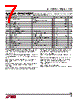
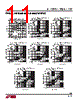
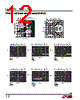
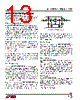
️· Op-Amps: LT1722, LT1723, LT1724. They're likely intended for similar applications, but the LT1723 and LT1724 likely have variations in their function compared to the 1722.
️· Versions: Each op-amp has two main versions:
- C (Common): Guaranteed performance from 0°C to 70°C. Designed but not QA sampled outside of this range.
- I (Industrial): Guaranteed performance from -40°C to 85°C. More robust for wider operating conditions.
2. Key Electrical Characteristics (Summarized, highlighting variations)
I'll structure this by category and mention key differences between versions where relevant. Please note that this isn't an exhaustive list - it’s highlighting significant specifications.
️· Absolute Maximum Ratings: (Not fully detailed, but present limits for voltage, power, temperature)
️· Input Characteristics:
- Input Protection: Back-to-back diodes protect input, limiting current.
️· Input Offset Voltage (VOS):
- Ranges from approximately 900 µV to 1200 µV (C Version, 0-70°C) to 1000 µV to 1200 µV (I Version, -40 to 85°C)
- Pulse tested, excludes warm-up drift.
️· Input Bias Current: (Not fully specified, but crucial for low-current circuits)
️· Input Offset Current: (Not fully specified)
️· Open-Loop Gain: (Not fully specified)
️· Common-Mode Rejection Ratio (CMRR): Around 75 dB. Important for suppressing noise on the input.
️· Power Supply Rejection Ratio (PSRR): Around 75 dB. Important for dealing with unstable power supplies.
️· Slew Rate (SR): Ranges from 20 to 100 V/µs. Determines how quickly the output voltage can change.
️· Full Power Bandwidth (FPBW): Calculated from the slew rate.
️· Output Voltage Swing: Ranges from approximately 1.5V to 3.55V.
️· Output Current: Ranges from 8mA to 20mA
️· Short-Circuit Current: Ranges from 10mA to 25mA.
️· Supply Current: Ranges from 5.95mA to 6.45mA.
️· Gain-Bandwidth Product (GBW): Not explicitly stated but related to the slew rate and full power bandwidth.
3. Important Notes (Read Carefully!)
️· Temperature Ranges: The operational amplifier's performance (especially regarding input offset voltage and other parameters) changes significantly with temperature. Pay attention to the temperature ranges for the "C" and "I" versions when selecting a part.
️· Testing and QA: The "C" version is *not* QA sampled outside of its 0-70°C range. This implies there's less assurance of performance outside that range.
️· Warm-Up Drift: The input offset voltage is tested using pulse testing, which excludes warm-up drift.
️· Correlation of GBW and Slew Rate: The Gain-Bandwidth Product (GBW) is not directly tested, but it is guaranteed through correlation with the Slew Rate.
1. General Information & Versions
️· Op-Amps: LT1722, LT1723, LT1724. They're likely intended for similar applications, but the LT1723 and LT1724 likely have variations in their function compared to the 1722.
️· Versions: Each op-amp has two main versions:
- C (Common): Guaranteed performance from 0°C to 70°C. Designed but not QA sampled outside of this range.
- I (Industrial): Guaranteed performance from -40°C to 85°C. More robust for wider operating conditions.
2. Key Electrical Characteristics (Summarized, highlighting variations)
I'll structure this by category and mention key differences between versions where relevant. Please note that this isn't an exhaustive list - it’s highlighting significant specifications.
️· Absolute Maximum Ratings: (Not fully detailed, but present limits for voltage, power, temperature)
️· Input Characteristics:
- Input Protection: Back-to-back diodes protect input, limiting current.
️· Input Offset Voltage (VOS):
- Ranges from approximately 900 µV to 1200 µV (C Version, 0-70°C) to 1000 µV to 1200 µV (I Version, -40 to 85°C)
- Pulse tested, excludes warm-up drift.
️· Input Bias Current: (Not fully specified, but crucial for low-current circuits)
️· Input Offset Current: (Not fully specified)
️· Open-Loop Gain: (Not fully specified)
️· Common-Mode Rejection Ratio (CMRR): Around 75 dB. Important for suppressing noise on the input.
️· Power Supply Rejection Ratio (PSRR): Around 75 dB. Important for dealing with unstable power supplies.
️· Slew Rate (SR): Ranges from 20 to 100 V/µs. Determines how quickly the output voltage can change.
️· Full Power Bandwidth (FPBW): Calculated from the slew rate.
️· Output Voltage Swing: Ranges from approximately 1.5V to 3.55V.
️· Output Current: Ranges from 8mA to 20mA
️· Short-Circuit Current: Ranges from 10mA to 25mA.
️· Supply Current: Ranges from 5.95mA to 6.45mA.
️· Gain-Bandwidth Product (GBW): Not explicitly stated but related to the slew rate and full power bandwidth.
3. Important Notes (Read Carefully!)
️· Temperature Ranges: The operational amplifier's performance (especially regarding input offset voltage and other parameters) changes significantly with temperature. Pay attention to the temperature ranges for the "C" and "I" versions when selecting a part.
️· Testing and QA: The "C" version is *not* QA sampled outside of its 0-70°C range. This implies there's less assurance of performance outside that range.
️· Warm-Up Drift: The input offset voltage is tested using pulse testing, which excludes warm-up drift.
️· Correlation of GBW and Slew Rate: The Gain-Bandwidth Product (GBW) is not directly tested, but it is guaranteed through correlation with the Slew Rate.
| Part No. | LT1723_15 |
| Manufacturer | LINER |
| Size | 304 Kbytes |
| Pages | 18 pages |
| Description | Single, Dual, Quad 200MHz Low Noise Precision Op Amps |
| Lei ha avuto il aiuto da alldatasheet? [ DONATE ] |
Di alldatasheet | Richest di pubblicita | contatti | Privacy Policy | Collegamento alla scheda tecnica | scambio Link | Ricerca produttore All Rights Reserved©Alldatasheet.com |
| Russian : Alldatasheetru.com | Korean : Alldatasheet.co.kr | Spanish : Alldatasheet.es | French : Alldatasheet.fr | Italian : Alldatasheetit.com Portuguese : Alldatasheetpt.com | Polish : Alldatasheet.pl | Vietnamese : Alldatasheet.vn Indian : Alldatasheet.in | Mexican : Alldatasheet.com.mx | British : Alldatasheet.co.uk | New Zealand : Alldatasheet.co.nz |
|
Family Site : ic2ic.com |
icmetro.com |
 Italian ▼
  English
 Chinese
 German
 Japanese
 Russian
 Korean
 Spanish
 French
 Portuguese
 Polish
 Vietnamese
 Indian
 Mexican
 British
 New Zealand