 |
Motore di ricerca datesheet componenti elettronici |
|
|
Motore di ricerca datesheet componenti elettronici |
|
The question interval is too short.
Please try again in a few seconds.

Hello, Please ask a question about 04KBL Datasheet
# Example questions:
➢ What is the maximum operating and storage temperature range for the bridge rectifiers described in the document?
➢ What is the maximum non-repetitive surge current for these rectifiers?
➢ What is the minimum breakdown voltage (circuit to case) specified for these bridge rectifiers?
| Part No. | 04KBL |
| Manufacturer | DEC |
| Size | 352 Kbytes |
| Pages | 2 pages |
| Description | 4 AMP SILICON BRIDGE RECTIFIERS |

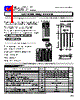

1. Overview & General Information
️· Product: DIOTEC Silicon Bridge Rectifiers, KBL Series.
️· Data Sheet No.: BKBL-400-2C.
️· Purpose: This document provides the electrical characteristics, ratings, and performance curves for these bridge rectifiers. Bridge rectifiers are used to convert AC voltage to DC voltage. This particular series has a rating of 4 Amps.
️· Rating Types: Different "KBL" series models are listed (KBL00 through KBL10), indicating variations within the general KBL series, likely varying in voltage or other characteristics. *You'd need the full spec sheet for each to know the differences.*
️· Manufacturing: By DIOTEC Electronics Corp.
️· Contact Info: DIOTEC's address and contact information (phone, fax) are provided.
2. Electrical Ratings & Characteristics (Key Numbers – Refer to Sheet)
️· Ratings are Critical: These tell you the limits within which the rectifier can operate safely. Exceeding these limits can cause damage.
️· Key Parameters: Here's a list of the most vital ratings. *Refer to the data sheet itself for the actual numerical values for each KBL series model.*
- Maximum Repetitive Peak Reverse Voltage (VRRM/VDRM): The maximum reverse voltage the rectifier can withstand in its normal operating cycle.
- Maximum Average Forward Current (IF(AV)): The average current flowing through the rectifier in a given time period. (4 Amps for this series).
- Maximum Non-Repetitive Peak Forward Surge Current (IFSM): The maximum current the rectifier can handle for a very short duration (pulse).
- Maximum Junction Temperature (Tj): The maximum permissible temperature of the semiconductor junction inside the rectifier.
- Minimum Insulation Breakdown Voltage (Circuit to Case): The voltage that needs to be applied to break down the insulation between the circuit and the case.
- Operating and Storage Temperature Range: The permissible temperature range the rectifier can operate and store.
3. Performance Curves & Figures (Highly Important for Understanding Behavior)
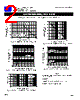
️· Figure 2: Maximum Non-Repetitive Surge Current: Shows how the surge current capability changes with pulse width and repetition rate. A shorter pulse allows a higher surge current.
️· Figure 3: Typical Forward Characteristic Per Diode: Shows the relationship between forward voltage (Vf) and forward current (IF). As current increases, the forward voltage drop increases.
️· Figure 4: Typical Reverse Characteristics: Illustrates the reverse leakage current (how much current leaks through when it's supposed to be blocking).
️· Figure 1: Forward Current Derating Curve: Shows how the maximum forward current decreases as the ambient temperature increases.
️· Figure 5: Typical Junction Capacitance Per Diode: Shows how the capacitance varies with voltage – important for high-frequency applications.
4. Notes (Important Explanations)
️· (1) Mounting: Indicates the rectifier is typically mounted on a specific aluminum plate size and thickness for heat dissipation. *Proper heat sinking is crucial for the rectifier to operate within its specified limits.*
️· (2) Surge Current Testing: Describes the conditions under which the surge current rating was determined.
️· (3) Temperature Definition: Specifies the temperature used for certain tests (25°C).
️· (4) Capacitance Measurement: Defines the conditions used to measure junction capacitance.
Key Technical Terms Explained
️· Bridge Rectifier: A circuit using four diodes to convert AC to DC, providing both positive and negative DC voltages.
️· AC (Alternating Current): Current that periodically reverses direction.
️· DC (Direct Current): Current that flows in one direction only.
️· VRRM/VDRM (Peak Reverse Voltage): The maximum voltage the rectifier can safely block in the reverse direction.
️· IF(AV) (Average Forward Current): The average current flowing through the rectifier.
️· IFSM (Peak Surge Current): The maximum current the rectifier can handle for a short time.
️· Tj (Junction Temperature): The temperature of the silicon chip inside the rectifier. This is a critical temperature to manage, as exceeding the limit can cause failure.
️· Heat Sink: A device (often metal) used to dissipate heat from the rectifier.
️· Junction Capacitance: A parasitic capacitance associated with the diode junction, which can affect high-frequency performance.
1. Overview & General Information
️· Product: DIOTEC Silicon Bridge Rectifiers, KBL Series.
️· Data Sheet No.: BKBL-400-2C.
️· Purpose: This document provides the electrical characteristics, ratings, and performance curves for these bridge rectifiers. Bridge rectifiers are used to convert AC voltage to DC voltage. This particular series has a rating of 4 Amps.
️· Rating Types: Different "KBL" series models are listed (KBL00 through KBL10), indicating variations within the general KBL series, likely varying in voltage or other characteristics. *You'd need the full spec sheet for each to know the differences.*
️· Manufacturing: By DIOTEC Electronics Corp.
️· Contact Info: DIOTEC's address and contact information (phone, fax) are provided.
2. Electrical Ratings & Characteristics (Key Numbers – Refer to Sheet)
️· Ratings are Critical: These tell you the limits within which the rectifier can operate safely. Exceeding these limits can cause damage.
️· Key Parameters: Here's a list of the most vital ratings. *Refer to the data sheet itself for the actual numerical values for each KBL series model.*
- Maximum Repetitive Peak Reverse Voltage (VRRM/VDRM): The maximum reverse voltage the rectifier can withstand in its normal operating cycle.
- Maximum Average Forward Current (IF(AV)): The average current flowing through the rectifier in a given time period. (4 Amps for this series).
- Maximum Non-Repetitive Peak Forward Surge Current (IFSM): The maximum current the rectifier can handle for a very short duration (pulse).
- Maximum Junction Temperature (Tj): The maximum permissible temperature of the semiconductor junction inside the rectifier.
- Minimum Insulation Breakdown Voltage (Circuit to Case): The voltage that needs to be applied to break down the insulation between the circuit and the case.
- Operating and Storage Temperature Range: The permissible temperature range the rectifier can operate and store.
3. Performance Curves & Figures (Highly Important for Understanding Behavior)
️· Figure 2: Maximum Non-Repetitive Surge Current: Shows how the surge current capability changes with pulse width and repetition rate. A shorter pulse allows a higher surge current.
️· Figure 3: Typical Forward Characteristic Per Diode: Shows the relationship between forward voltage (Vf) and forward current (IF). As current increases, the forward voltage drop increases.
️· Figure 4: Typical Reverse Characteristics: Illustrates the reverse leakage current (how much current leaks through when it's supposed to be blocking).
️· Figure 1: Forward Current Derating Curve: Shows how the maximum forward current decreases as the ambient temperature increases.
️· Figure 5: Typical Junction Capacitance Per Diode: Shows how the capacitance varies with voltage – important for high-frequency applications.
4. Notes (Important Explanations)
️· (1) Mounting: Indicates the rectifier is typically mounted on a specific aluminum plate size and thickness for heat dissipation. *Proper heat sinking is crucial for the rectifier to operate within its specified limits.*
️· (2) Surge Current Testing: Describes the conditions under which the surge current rating was determined.
️· (3) Temperature Definition: Specifies the temperature used for certain tests (25°C).
️· (4) Capacitance Measurement: Defines the conditions used to measure junction capacitance.
Key Technical Terms Explained
️· Bridge Rectifier: A circuit using four diodes to convert AC to DC, providing both positive and negative DC voltages.
️· AC (Alternating Current): Current that periodically reverses direction.
️· DC (Direct Current): Current that flows in one direction only.
️· VRRM/VDRM (Peak Reverse Voltage): The maximum voltage the rectifier can safely block in the reverse direction.
️· IF(AV) (Average Forward Current): The average current flowing through the rectifier.
️· IFSM (Peak Surge Current): The maximum current the rectifier can handle for a short time.
️· Tj (Junction Temperature): The temperature of the silicon chip inside the rectifier. This is a critical temperature to manage, as exceeding the limit can cause failure.
️· Heat Sink: A device (often metal) used to dissipate heat from the rectifier.
️· Junction Capacitance: A parasitic capacitance associated with the diode junction, which can affect high-frequency performance.
| Part No. | 04KBL |
| Manufacturer | DEC |
| Size | 352 Kbytes |
| Pages | 2 pages |
| Description | 4 AMP SILICON BRIDGE RECTIFIERS |
| Lei ha avuto il aiuto da alldatasheet? [ DONATE ] |
Di alldatasheet | Richest di pubblicita | contatti | Privacy Policy | Collegamento alla scheda tecnica | scambio Link | Ricerca produttore All Rights Reserved©Alldatasheet.com |
| Russian : Alldatasheetru.com | Korean : Alldatasheet.co.kr | Spanish : Alldatasheet.es | French : Alldatasheet.fr | Italian : Alldatasheetit.com Portuguese : Alldatasheetpt.com | Polish : Alldatasheet.pl | Vietnamese : Alldatasheet.vn Indian : Alldatasheet.in | Mexican : Alldatasheet.com.mx | British : Alldatasheet.co.uk | New Zealand : Alldatasheet.co.nz |
|
Family Site : ic2ic.com |
icmetro.com |
 Italian ▼
  English
 Chinese
 German
 Japanese
 Russian
 Korean
 Spanish
 French
 Portuguese
 Polish
 Vietnamese
 Indian
 Mexican
 British
 New Zealand