 |
Motore di ricerca datesheet componenti elettronici |
|
|
Motore di ricerca datesheet componenti elettronici |
|
The question interval is too short.
Please try again in a few seconds.

Hello, Please ask a question about FFB20UP20DN Datasheet
# Example questions:
➢ What does 'formative or in design' imply about the information presented in the datasheet?
➢ What is the maximum reverse voltage (vr) specified in the datasheet, and what is its corresponding typical reverse current (ir) at tc = 25°c?
➢ How does the forward voltage drop change as the current increases?
| Part No. | FFB20UP20DN |
| Manufacturer | FAIRCHILD |
| Size | 942 Kbytes |
| Pages | 5 pages |
| Description | 10A, 200V Ultrafast Dual Rectifiers |

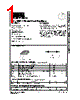

1. General Information
️· Part Number: FFB20UP20DN
️· Manufacturer: Fairchild Semiconductor
️· Device Type: Rectifier (likely a Schottky rectifier due to characteristics)
️· Operating Temperature Range (Junction and Storage): -55°C to +175°C
️· Datasheet Revision: Rev. A
️· Website: www.fairchildsemi.com
️· Status: The datasheet notes that the manufacturer reserves the right to make changes without notice. This is standard in the semiconductor industry.
2. Electrical Characteristics (Key Values Extracted - See Note at the End)
️· VRRM (Peak Repetitive Reverse Voltage): 200V
️· VRWM (Working Peak Reverse Voltage): 200V
️· VR (DC Blocking Voltage): 200V
️· If(avg) (Average Rectified Forward Current @ TC = 155°C): 10A
️· IFSM (Non-repetitive Peak Surge Current @ 60Hz Single Half-Sine Wave): 100A
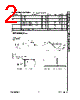
️· VF (Forward Voltage @ IF = 10A, different temperatures):
- TC = 25°C: 1.0V (typical)
- TC = 150°C: 1.15V
️· IR (Reverse Current @ VR = 200V):
- TC = 25°C: 10 µA
- TC = 150°C: 250 µA
️· trr (Reverse Recovery Time):
- IF = 1A, di/dt = 200A/µs, VCC= 130V: 15ns
- IF = 10A, di/dt = 200A/µs, VCC= 130V: 27ns
️· ta & tb (Not clearly defined within this excerpt - likely related to timing characteristics): Values are provided.
️· Qrr (Reverse Recovery Charge): 50nC
️· Avalanche Energy (L = 20mH): 10 mJ
3. Charts and Figures (Descriptions)
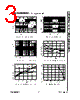
️· Figure 1: Typical Forward Voltage Drop: Shows the forward voltage versus forward current for the rectifier at different junction temperatures (175°C, 100°C, and 25°C).
️· Figure 2: Typical Reverse Current: Shows the reverse current versus reverse voltage at different junction temperatures.
️· Figure 3: Typical Reverse Recovery Time: Shows reverse recovery time versus forward current and di/dt.
️· Figure 3: Typical Junction Capacitance: Shows the junction capacitance versus reverse voltage.
️· Figure 1: Typical Reverse Recovery Current: Shows reverse recovery current characteristics.
️· Figure 3: Case Temperature vs. Rectifier Characteristics: A chart illustrating how device characteristics change with case temperature.
4. Revision Information
️· Revision: Rev. A.
️· The footer mentions "Rev. I20," which likely refers to an internal revision code within Fairchild Semiconductor's documentation system.
Important Notes & Caveats:
️· Partial Data Sheet: This is *not* the complete data sheet. It's an excerpt. There would be mechanical dimensions, reliability information, and potentially other performance metrics in a full data sheet.
️· Technical Language: Semiconductor data sheets are filled with technical jargon. A deep understanding of electronics is helpful to interpret all the data.
️· Operating Conditions: The specifications provided are usually given for specific operating conditions. Read the full data sheet to understand these conditions.
️· "Typical" vs. "Maximum": Data sheets often provide "typical" values, which are representative of a normal device. "Maximum" values are the absolute limits that the device can handle without damage.
1. General Information
️· Part Number: FFB20UP20DN
️· Manufacturer: Fairchild Semiconductor
️· Device Type: Rectifier (likely a Schottky rectifier due to characteristics)
️· Operating Temperature Range (Junction and Storage): -55°C to +175°C
️· Datasheet Revision: Rev. A
️· Website: www.fairchildsemi.com
️· Status: The datasheet notes that the manufacturer reserves the right to make changes without notice. This is standard in the semiconductor industry.
2. Electrical Characteristics (Key Values Extracted - See Note at the End)
️· VRRM (Peak Repetitive Reverse Voltage): 200V
️· VRWM (Working Peak Reverse Voltage): 200V
️· VR (DC Blocking Voltage): 200V
️· If(avg) (Average Rectified Forward Current @ TC = 155°C): 10A
️· IFSM (Non-repetitive Peak Surge Current @ 60Hz Single Half-Sine Wave): 100A
️· VF (Forward Voltage @ IF = 10A, different temperatures):
- TC = 25°C: 1.0V (typical)
- TC = 150°C: 1.15V
️· IR (Reverse Current @ VR = 200V):
- TC = 25°C: 10 µA
- TC = 150°C: 250 µA
️· trr (Reverse Recovery Time):
- IF = 1A, di/dt = 200A/µs, VCC= 130V: 15ns
- IF = 10A, di/dt = 200A/µs, VCC= 130V: 27ns
️· ta & tb (Not clearly defined within this excerpt - likely related to timing characteristics): Values are provided.
️· Qrr (Reverse Recovery Charge): 50nC
️· Avalanche Energy (L = 20mH): 10 mJ
3. Charts and Figures (Descriptions)
️· Figure 1: Typical Forward Voltage Drop: Shows the forward voltage versus forward current for the rectifier at different junction temperatures (175°C, 100°C, and 25°C).
️· Figure 2: Typical Reverse Current: Shows the reverse current versus reverse voltage at different junction temperatures.
️· Figure 3: Typical Reverse Recovery Time: Shows reverse recovery time versus forward current and di/dt.
️· Figure 3: Typical Junction Capacitance: Shows the junction capacitance versus reverse voltage.
️· Figure 1: Typical Reverse Recovery Current: Shows reverse recovery current characteristics.
️· Figure 3: Case Temperature vs. Rectifier Characteristics: A chart illustrating how device characteristics change with case temperature.
4. Revision Information
️· Revision: Rev. A.
️· The footer mentions "Rev. I20," which likely refers to an internal revision code within Fairchild Semiconductor's documentation system.
Important Notes & Caveats:
️· Partial Data Sheet: This is *not* the complete data sheet. It's an excerpt. There would be mechanical dimensions, reliability information, and potentially other performance metrics in a full data sheet.
️· Technical Language: Semiconductor data sheets are filled with technical jargon. A deep understanding of electronics is helpful to interpret all the data.
️· Operating Conditions: The specifications provided are usually given for specific operating conditions. Read the full data sheet to understand these conditions.
️· "Typical" vs. "Maximum": Data sheets often provide "typical" values, which are representative of a normal device. "Maximum" values are the absolute limits that the device can handle without damage.
| Part No. | FFB20UP20DN |
| Manufacturer | FAIRCHILD |
| Size | 942 Kbytes |
| Pages | 5 pages |
| Description | 10A, 200V Ultrafast Dual Rectifiers |
| Lei ha avuto il aiuto da alldatasheet? [ DONATE ] |
Di alldatasheet | Richest di pubblicita | contatti | Privacy Policy | Collegamento alla scheda tecnica | scambio Link | Ricerca produttore All Rights Reserved©Alldatasheet.com |
| Russian : Alldatasheetru.com | Korean : Alldatasheet.co.kr | Spanish : Alldatasheet.es | French : Alldatasheet.fr | Italian : Alldatasheetit.com Portuguese : Alldatasheetpt.com | Polish : Alldatasheet.pl | Vietnamese : Alldatasheet.vn Indian : Alldatasheet.in | Mexican : Alldatasheet.com.mx | British : Alldatasheet.co.uk | New Zealand : Alldatasheet.co.nz |
|
Family Site : ic2ic.com |
icmetro.com |
 Italian ▼
  English
 Chinese
 German
 Japanese
 Russian
 Korean
 Spanish
 French
 Portuguese
 Polish
 Vietnamese
 Indian
 Mexican
 British
 New Zealand