 |
Motore di ricerca datesheet componenti elettronici |
|
|
Motore di ricerca datesheet componenti elettronici |
|
The question interval is too short.
Please try again in a few seconds.

Hello, Please ask a question about EM488M1644VTF Datasheet
# Example questions:
➢ What is the full page size in bits, as defined within the documentation?
➢ If a read command (read) is issued, what signal must be valid to indicate data is being received?
➢ How many auto refresh cycles are required after a mode register set (mrs) command before valid data can be expected?
| Part No. | EM488M1644VTF |
| Manufacturer | EOREX |
| Size | 651 Kbytes |
| Pages | 18 pages |
| Description | 128Mb (2M횞4Bank횞16) Synchronous DRAM |

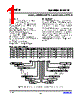
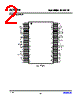
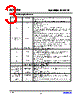
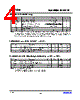
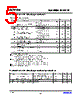
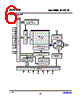
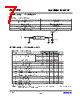
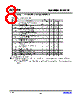
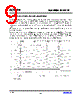
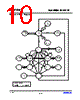


1. Initialization and Basic Operation
️· Initial State: After power-up or reset, all banks of the SDRAM are in a precharge state.
️· Bank Activation (ACT): The first command required for any operation is to activate a bank. This is done using the `ACT` command.
️· Precharge (PRE): Before exiting a bank, it must be precharged. This resets the bank for subsequent operations.
️· Mode Register Set (MRS): The `MRS` command configures various parameters of the SDRAM, such as refresh rate and CAS latency. This must be executed before any other operation.
2. Command Truth Table Explanation
The truth table details the signals needed for each command. Here's a breakdown of the signals and what they mean:
️· CKE (Clock Enable): Controls the clock signal going to the device. It's high to enable the clock; low disables it.
️· RAS (Row Address Strobe): Activates a row in the memory.
️· CAS (Column Address Strobe): Selects a column within the activated row.
️· /WE (Write Enable): Determines if the command is a read or write operation. High for read; low for write.
️· A10, BA1, BA0 (Address Lines): Used for selecting banks, rows, columns, and configuring the device.
Common Commands and their Signals:
️· NOP (No Operation): Does nothing. Useful for timing and synchronization.
️· DESL (Device Select Low): Device selection.
️· BSTH (Burst Stop High): Stops an ongoing burst.
️· READ: Reads data from the memory.
️· READA: Read with Auto Precharge.
️· WRITE: Writes data to the memory.
️· WRITA: Write with Auto Precharge.
️· ACT (Activate): Selects a bank and row.
️· PRE (Precharge): Precharges a bank.
️· PALL (Precharge All): Precharges all banks.
️· MRS (Mode Register Set): Configures operating parameters.
Key Points
️· The device requires a specific sequence of commands to be executed properly.
️· Timing is critical. There are minimum and maximum times that commands can be issued relative to each other. (These aren't detailed in the extract, but are vital for SDRAM operation.)
️· The command truth table shows the binary signal levels that define each command.
1. Initialization and Basic Operation
️· Initial State: After power-up or reset, all banks of the SDRAM are in a precharge state.
️· Bank Activation (ACT): The first command required for any operation is to activate a bank. This is done using the `ACT` command.
️· Precharge (PRE): Before exiting a bank, it must be precharged. This resets the bank for subsequent operations.
️· Mode Register Set (MRS): The `MRS` command configures various parameters of the SDRAM, such as refresh rate and CAS latency. This must be executed before any other operation.
2. Command Truth Table Explanation
The truth table details the signals needed for each command. Here's a breakdown of the signals and what they mean:
️· CKE (Clock Enable): Controls the clock signal going to the device. It's high to enable the clock; low disables it.
️· RAS (Row Address Strobe): Activates a row in the memory.
️· CAS (Column Address Strobe): Selects a column within the activated row.
️· /WE (Write Enable): Determines if the command is a read or write operation. High for read; low for write.
️· A10, BA1, BA0 (Address Lines): Used for selecting banks, rows, columns, and configuring the device.
Common Commands and their Signals:
️· NOP (No Operation): Does nothing. Useful for timing and synchronization.
️· DESL (Device Select Low): Device selection.
️· BSTH (Burst Stop High): Stops an ongoing burst.
️· READ: Reads data from the memory.
️· READA: Read with Auto Precharge.
️· WRITE: Writes data to the memory.
️· WRITA: Write with Auto Precharge.
️· ACT (Activate): Selects a bank and row.
️· PRE (Precharge): Precharges a bank.
️· PALL (Precharge All): Precharges all banks.
️· MRS (Mode Register Set): Configures operating parameters.
Key Points
️· The device requires a specific sequence of commands to be executed properly.
️· Timing is critical. There are minimum and maximum times that commands can be issued relative to each other. (These aren't detailed in the extract, but are vital for SDRAM operation.)
️· The command truth table shows the binary signal levels that define each command.
| Part No. | EM488M1644VTF |
| Manufacturer | EOREX |
| Size | 651 Kbytes |
| Pages | 18 pages |
| Description | 128Mb (2M횞4Bank횞16) Synchronous DRAM |
| Lei ha avuto il aiuto da alldatasheet? [ DONATE ] |
Di alldatasheet | Richest di pubblicita | contatti | Privacy Policy | Collegamento alla scheda tecnica | scambio Link | Ricerca produttore All Rights Reserved©Alldatasheet.com |
| Russian : Alldatasheetru.com | Korean : Alldatasheet.co.kr | Spanish : Alldatasheet.es | French : Alldatasheet.fr | Italian : Alldatasheetit.com Portuguese : Alldatasheetpt.com | Polish : Alldatasheet.pl | Vietnamese : Alldatasheet.vn Indian : Alldatasheet.in | Mexican : Alldatasheet.com.mx | British : Alldatasheet.co.uk | New Zealand : Alldatasheet.co.nz |
|
Family Site : ic2ic.com |
icmetro.com |
 Italian ▼
  English
 Chinese
 German
 Japanese
 Russian
 Korean
 Spanish
 French
 Portuguese
 Polish
 Vietnamese
 Indian
 Mexican
 British
 New Zealand