 |
Motore di ricerca datesheet componenti elettronici |
|
|
Motore di ricerca datesheet componenti elettronici |
|
The question interval is too short.
Please try again in a few seconds.

Hello, Please ask a question about LT1124 Datasheet
# Example questions:
➢ What is the typical input noise voltage density (in nv/√hz) for the lt1124c/i/m at fo = 1000hz?
➢ What is the typical maximum output voltage swing (in volts) for the lt1124c/i/m when rl ≥ 2k?
➢ What is the typical slew rate (in v/µs) for the lt1125am?
| Part No. | LT1124 |
| Manufacturer | LINER |
| Size | 227 Kbytes |
| Pages | 16 pages |
| Description | Dual/Quad Low Noise, High Speed Precision Op Amps |


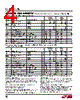
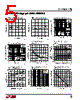
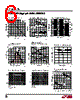


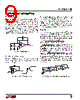
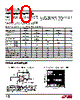
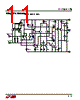
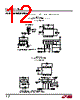


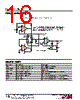

Okay, let's break down this extracted data. It appears to be a collection of specifications for various versions of the LT1124 and LT1125 operational amplifiers (op-amps), specifically the AC, AI, AM, C, I, and M versions.
Here's a structured summary of the information, organized by key categories, along with explanations:
1. General Information & Notation:
️· LT1124 & LT1125: These are the base model numbers of the op-amp series.
️· Suffixes (AC, AI, AM, C, I, M): These denote specific variants of the op-amp, each with slightly different characteristics (offset voltage, noise, temperature range, etc.). The specifications provided differentiate between these versions.
️· "G" Notation: This signifies that the values listed apply over a specified temperature range (-55°C ≤ TA ≤ 125°C).
️· "Note X": Indicates a footnote providing additional context for the specification. It's important to check these notes for full understanding.
2. Electrical Specifications (Key Parameters and their Ranges):
Here's a summary table. Due to the length, I'm highlighting key differences. (Note: The numbers in this table are a simplified representation based on the provided text.) "Typical" values are often denoted by "Typ" and may have specific values provided.
| Parameter | LT1124/1125 AC/AI/AM (G) | LT1124/1125 C/I/M (G) | Notes/Explanation |
| ----------------------- | ----------------------- | ----------------------- | --------------------------------------------------------------------------------------------------------------- |
| Input Offset Voltage (VOS) | 50-170 µV (Typ: 110) | 60-250 µV (Typ: 155)| Difference in inherent offset voltage. Lower is generally better. |
| Input Bias Current (IB) | ±18-55 nA | ±20-70 nA | Small current flowing into the input. Lower is generally better. |
| Input Voltage Range (VCM) | ±11.3-12 V | ±11.3-12V | Maximum acceptable common-mode voltage. |
| Common Mode Rejection Ratio (CMRR) | 106-122 dB | 100-120 dB | Ability to reject unwanted common-mode signals. Higher is better. |
| Power Supply Rejection Ratio (PSRR) | 110-122 dB | 104-120 dB | Ability to reject changes in the supply voltage. Higher is better. |
| Large Signal Voltage Gain (AVOL) | 3-10 V/µV | 2-7 V/µV | Amplification factor for large signals. Higher is better. |
| Maximum Output Voltage Swing (VOUT) | ±12.5-13.6 V | ±12-13.6 V | Maximum voltage the output can reach. |
| Slew Rate (SR) | 2.3 - 3.8 V/µs | 2 - 3.8 V/µs | Rate of voltage change in the output. Affects how fast the amplifier responds to signals. |
| Supply Current (IS) | 2.5 - 3.25 mA | 2.5 - 3.25 mA | Current drawn from the power supply. |
3. Important Considerations & Interpretations:
️· Temperature Range: The "G" designation is critical. All specs listed with "G" are specifically valid within -55°C to 125°C. Operating outside this range may affect performance.
️· "Typical" Values: Pay attention to the "Typical" (Typ) values, as these are the most likely values you're going to see in most operating conditions.
️· Noise Performance: Specifications like Input Noise Voltage and Input Noise Current Density are important for sensitive applications.
️· Gain Bandwidth Product (GBW): A key parameter that defines the usable frequency range of the amplifier.
️· Slew Rate: Impacts the amplifier's ability to handle fast-changing signals.
️· Note Footnotes: The notes provide essential context and caveats for understanding the specifications. You *must* refer to them!
In summary, the provided data offers a detailed comparative analysis of the LT1124 and LT1125 op-amp families, allowing engineers to select the optimal variant for their specific application based on performance trade-offs.
To give more targeted information, can you provide more specific questions about the data? For instance, are you interested in comparing specific versions of the op-amp for a certain application?
Here's a structured summary of the information, organized by key categories, along with explanations:
1. General Information & Notation:
️· LT1124 & LT1125: These are the base model numbers of the op-amp series.
️· Suffixes (AC, AI, AM, C, I, M): These denote specific variants of the op-amp, each with slightly different characteristics (offset voltage, noise, temperature range, etc.). The specifications provided differentiate between these versions.
️· "G" Notation: This signifies that the values listed apply over a specified temperature range (-55°C ≤ TA ≤ 125°C).
️· "Note X": Indicates a footnote providing additional context for the specification. It's important to check these notes for full understanding.
2. Electrical Specifications (Key Parameters and their Ranges):
| Parameter | LT1124/1125 AC/AI/AM (G) | LT1124/1125 C/I/M (G) | Notes/Explanation |
|---|---|---|---|
| Input Offset Voltage (VOS) | 50-170 µV (Typ: 110) | 60-250 µV (Typ: 155) | Difference in inherent offset voltage. Lower is generally better. |
| Input Bias Current (IB) | ±18-55 nA | ±20-70 nA | Small current flowing into the input. Lower is generally better. |
| Input Voltage Range (VCM) | ±11.3-12 V | ±11.3-12V | Maximum acceptable common-mode voltage. |
| Common Mode Rejection Ratio (CMRR) | 106-122 dB | 100-120 dB | Ability to reject unwanted common-mode signals. Higher is better. |
| Power Supply Rejection Ratio (PSRR) | 110-122 dB | 104-120 dB | Ability to reject changes in the supply voltage. Higher is better. |
| Large Signal Voltage Gain (AVOL) | 3-10 V/µV | 2-7 V/µV | Amplification factor for large signals. Higher is better. |
| Maximum Output Voltage Swing (VOUT) | ±12.5-13.6 V | ±12-13.6 V | Maximum voltage the output can reach. |
| Slew Rate (SR) | 2.3 - 3.8 V/µs | 2 - 3.8 V/µs | Rate of voltage change in the output. Affects how fast the amplifier responds to signals. |
| Supply Current (IS) | 2.5 - 3.25 mA | 2.5 - 3.25 mA | Current drawn from the power supply. |
| Part No. | LT1124 |
| Manufacturer | LINER |
| Size | 227 Kbytes |
| Pages | 16 pages |
| Description | Dual/Quad Low Noise, High Speed Precision Op Amps |
| Lei ha avuto il aiuto da alldatasheet? [ DONATE ] |
Di alldatasheet | Richest di pubblicita | contatti | Privacy Policy | Collegamento alla scheda tecnica | scambio Link | Ricerca produttore All Rights Reserved©Alldatasheet.com |
| Russian : Alldatasheetru.com | Korean : Alldatasheet.co.kr | Spanish : Alldatasheet.es | French : Alldatasheet.fr | Italian : Alldatasheetit.com Portuguese : Alldatasheetpt.com | Polish : Alldatasheet.pl | Vietnamese : Alldatasheet.vn Indian : Alldatasheet.in | Mexican : Alldatasheet.com.mx | British : Alldatasheet.co.uk | New Zealand : Alldatasheet.co.nz |
|
Family Site : ic2ic.com |
icmetro.com |
 Italian ▼
  English
 Chinese
 German
 Japanese
 Russian
 Korean
 Spanish
 French
 Portuguese
 Polish
 Vietnamese
 Indian
 Mexican
 British
 New Zealand