|
Motore di ricerca datesheet componenti elettronici |
|
|
Motore di ricerca datesheet componenti elettronici |
|
ARM920T Scheda tecnica(PDF) 4 Page - List of Unclassifed Manufacturers |
|
|
|||||||||||||||||||||||||||||
ARM920T Scheda tecnica(HTML) 4 Page - List of Unclassifed Manufacturers |
|
|
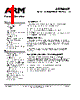
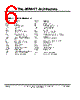
4 / 12 page  The ARMv4T Architecture Page 4 © Copyright ARM Limited 2000. All rights reserved. DVI 0024A ARM Confidential - Draft Registers The ARM9TDMI processor core consists of a 32-bit datapath and associated control logic. That datapath contains 31 general- purpose registers, coupled to a full shifter, Arithmetic Logic Unit, and multiplier. At any one time 16 registers are visible to the user. The remainder are synonyms used to speed up exception processing. Register 15 is the Program Counter (PC) and can be used in all instructions to reference data relative to the current instruction. R14 holds the return address after a subroutine call. R13 is used (by software convention) as a stack pointer. Modes and exception handling All exceptions have banked registers for R14 and R13. After an exception, R14 holds the return address for exception processing. This address is used both to return after the exception is processed and to address the instruction that caused the exception. R13 is banked across exception modes to provide each exception handler with a private stack pointer. The fast interrupt mode also banks registers 8 to 12 so that interrupt processing can begin without the need to save or restore these registers. A seventh processing mode, System mode, does not have any banked registers. It uses the User mode registers. System mode runs tasks that require a privileged processor mode and allows them to invoke all classes of exceptions. Status registers All other processor states are held in status registers. The current operating processor status is in the Current Program Status Register (CPSR). The CPSR holds: • four ALU flags (Negative, Zero, Carry, and Overflow), • two interrupt disable bits (one for each type of interrupt), • a bit to indicate ARM or Thumb execution, • and five bits to encode the current processor mode. All five exception modes also have a Saved Program Status Register (SPSR) which holds the CPSR of the task immediately before the exception occurred. Exception types ARM9TDMI supports five types of exception, and a privileged processing mode for each type. The types of exceptions are: • fast interrupt (FIQ) • normal interrupt (IRQ) • memory aborts (used to implement memory protection or virtual memory) • attempted execution of an undefined instruction • software interrupts (SWIs). Conditional execution All ARM instructions (with the exception of BLX) are conditionally executed. Instructions optionally update the four condition code flags (Negative, Zero, Carry, and Overflow) according to their result. Subsequent instructions are conditionally executed according to the status of flags. Fifteen conditions are implemented. Four classes of instructions The ARM and Thumb instruction sets can be divided into four broad classes of instruction: • data processing instructions • load and store instructions • branch instructions • coprocessor instructions. Data processing The data processing instructions operate on data held in general purpose registers. Of the two source operands, one is always a register. The other has two basic forms: • an immediate value • a register value optionally shifted. If the operand is a shifted register the shift amount might have an immediate value or the value of another register. Four types of shift can be specified. Most data processing instructions can perform a shift followed by a logical or arithmetic operation. Multiply instructions come in two classes: • normal - 32-bit result • long - 32-bit result variants. Both types of multiply instruction can optionally perform an accumulate operation. Load and store The second class of instruction is load and store instructions. These instructions come in two main types: • load or store the value of a single register • load and store multiple register values. |
|
|
Link URL |
| Lei ha avuto il aiuto da alldatasheet? [ DONATE ] |
Di alldatasheet | Richest di pubblicita | contatti | Privacy Policy | Collegamento alla scheda tecnica | scambio Link | Ricerca produttore All Rights Reserved©Alldatasheet.com |
| Russian : Alldatasheetru.com | Korean : Alldatasheet.co.kr | Spanish : Alldatasheet.es | French : Alldatasheet.fr | Italian : Alldatasheetit.com Portuguese : Alldatasheetpt.com | Polish : Alldatasheet.pl | Vietnamese : Alldatasheet.vn Indian : Alldatasheet.in | Mexican : Alldatasheet.com.mx | British : Alldatasheet.co.uk | New Zealand : Alldatasheet.co.nz |
|
Family Site : ic2ic.com |
icmetro.com |
 Italian ▼
 English
 Chinese
 German
 Japanese
 Russian
 Korean
 Spanish
 French
 Italian
 Portuguese
 Polish
 Vietnamese
 Indian
 Mexican
 British
 New Zealand